Circuit Components Utils
The |
|
The |
|
The s-parametrized Stratonovich-Weyl kernel as a |
|
A circuit component to perform trace-out operations. |
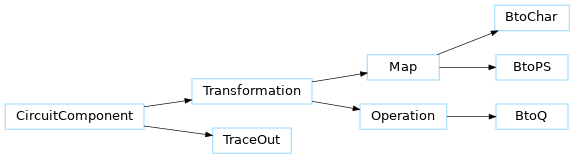
BtoChar
- class mrmustard.lab.circuit_components_utils.BtoChar(modes, s)[source]
Bases:
MapThe
s-parametrizedDgateas aMap. Also known as the Fourier transform of the Stratonovich-Weyl kernel. See https://arxiv.org/abs/quant-ph/9707010.This is an unphysical component whose purpose is to modify the internal representation of another component. In particular it transforms between the Bargmann representation and the s-parametrized Characteristic functions. Note that it can be applied to a subset of modes.
>>> from mrmustard.lab import BtoChar, GaussianKet
>>> from mrmustard import math
>>> chi = (GaussianKet.random([0]) >> BtoChar([0], s=0)).ansatz
>>> assert math.allclose(chi(0,0), 1.0)
- Parameters:
modes (int | tuple[int, ...]) – The modes of this channel.
s (float) – The
sparameter of this channel.
Details and Conventions
This class represents the transformation from the Bargmann (B) representation to characteristic function (Char).
Any operator, say O can be expressed in the displacement basis. Formally, we have that the s-parametrized phase space basis is characterized by the following operators
\[D_s(\alpha) = exp(s|\alpha|^2/2) D(\alpha).\]The s-parametrized phase space representation of an object O, would therefore be
\[\mathrm{Tr}(D_s(\alpha) O).\]Important s-parametrizations include:
s=1: returns the complex Fourier transform (or often called the symplectic Fourier transform) of Galuber-Sudarshan P function.
s=0: returns the characteristic function, which is equivalent to the complex Fourier transform of the Wigner function.
s=-1: returns the complex Fourier transform of the Q function.
- inverse()[source]
Returns the mathematical inverse of the transformation, if it exists. Note that it can be unphysical, for example when the original is not unitary.
>>> from mrmustard.lab import GaussianDM, Identity, Operation
>>> rho = GaussianDM.random(modes=0, seed=1)
>>> rho_as_operator = Operation.from_bargmann([0], [0], rho.ansatz.triple)
>>> assert rho_as_operator >> rho_as_operator.inverse() == Identity([0])
- Returns:
The inverse of the transformation.
- Raises:
NotImplementedError – If the input and output wires have different lengths.
NotImplementedError – If the transformation is not in the Bargmann representation.
- fock_array(shape=None)[source]
Returns an array representation of this component in the Fock basis with the given shape. If the shape is not given, it defaults to the
auto_shapeof the component.- Parameters:
shape (int | Sequence[int] | None) – The shape of the returned representation. If
shapeis given as anint, it is broadcasted to all the dimensions. If not given, it is generated viaauto_shape.- Returns:
The Fock representation of this component.
- Return type:
array
- Raises:
ValueError – If the shape is not valid for the component.
BtoQ
- class mrmustard.lab.circuit_components_utils.BtoQ(modes, phi=0.0)[source]
Bases:
OperationThe
Operationthat changes the representation of an object from Bargmann (B) into quadrature (Q). By default it’s defined on the output ket side.>>> from mrmustard import math >>> from mrmustard.lab import BtoQ, GaussianKet, QuadratureEigenstate >>> psi = GaussianKet.random([0]) >>> assert math.allclose(psi >> QuadratureEigenstate(0, x=1).dual, (psi >> BtoQ(0)).ansatz(1))
- Parameters:
modes (int | tuple[int, ...]) – The modes of this channel.
phi (float | Sequence[float]) – The quadrature angle.
0corresponds to the x quadrature, and \(\pi/2\) to the p quadrature.
- inverse()[source]
Returns the mathematical inverse of the transformation, if it exists. Note that it can be unphysical, for example when the original is not unitary.
>>> from mrmustard.lab import GaussianDM, Identity, Operation
>>> rho = GaussianDM.random(modes=0, seed=1)
>>> rho_as_operator = Operation.from_bargmann([0], [0], rho.ansatz.triple)
>>> assert rho_as_operator >> rho_as_operator.inverse() == Identity([0])
- Returns:
The inverse of the transformation.
- Raises:
NotImplementedError – If the input and output wires have different lengths.
NotImplementedError – If the transformation is not in the Bargmann representation.
- fock_array(shape=None)[source]
Returns an array representation of this component in the Fock basis with the given shape. If the shape is not given, it defaults to the
auto_shapeof the component.- Parameters:
shape (int | Sequence[int] | None) – The shape of the returned representation. If
shapeis given as anint, it is broadcasted to all the dimensions. If not given, it is generated viaauto_shape.- Returns:
The Fock representation of this component.
- Return type:
array
- Raises:
ValueError – If the shape is not valid for the component.
BtoPS
- class mrmustard.lab.circuit_components_utils.BtoPS(modes, s)[source]
Bases:
MapThe s-parametrized Stratonovich-Weyl kernel as a
Map.Used internally as a
Channelfor transformations between representations.- Parameters:
modes (int | tuple[int, ...]) – The modes of this channel.
s (float) – The s parameter of this channel. The case s=-1 corresponds to Husimi, s=0 to Wigner, and s=1 to Glauber P function.
- fock_array(shape=None)[source]
Returns an array representation of this component in the Fock basis with the given shape. If the shape is not given, it defaults to the
auto_shapeof the component.- Parameters:
shape (int | Sequence[int] | None) – The shape of the returned representation. If
shapeis given as anint, it is broadcasted to all the dimensions. If not given, it is generated viaauto_shape.- Returns:
The Fock representation of this component.
- Return type:
array
- Raises:
ValueError – If the shape is not valid for the component.
TraceOut
- class mrmustard.lab.circuit_components_utils.TraceOut(modes)[source]
Bases:
CircuitComponentA circuit component to perform trace-out operations.
It has input wires on both the ket and bra sides, but no output wires. Its representation is the same as that of the identity channel.
>>> from mrmustard.lab import *
>>> from mrmustard import math
>>> # initialize a multi-mode state
>>> state = Coherent(0, alpha=1) >> Coherent(1, alpha=1) >> Coherent(2, alpha=1)
>>> # trace out some of the modes
>>> assert state >> TraceOut(0) == (Coherent(1, alpha=1) >> Coherent(2, alpha=1)).dm()
>>> assert state >> TraceOut((1, 2)) == Coherent(0, alpha=1).dm()
>>> # use the trace out to estimate expectation values of operators
>>> op = Dgate(0, alpha=1)
>>> expectation = state.dm().contract(op) >> TraceOut((0, 1, 2))
>>> assert math.allclose(expectation, state.expectation(op))
- Parameters:
modes (int | tuple[int, ...]) – The modes to trace out.