States
The Bargmann eigenstate. |
|
The coherent state in Bargmann representation. |
|
Base class for density matrices. |
|
The displaced squeezed state in Bargmann representation. |
|
The N-mode mixed state described by a Gaussian gate that acts on a given thermal state. |
|
The N-mode pure state described by a Gaussian gate that acts on Vacuum. |
|
Base class for all Hilbert space vectors. |
|
The number state in Fock representation. |
|
The Quadrature eigenstate in Bargmann representation. |
|
The n-th Sauron state is an approximation of the n-th Fock states using a ring of n+1 coherent states. |
|
The squeezed vacuum state in Bargmann representation. |
|
Base class for all states. |
|
The thermal state in Bargmann representation. |
|
The two-mode squeezed vacuum state. |
|
The N-mode vacuum state in Bargmann representation. |
Inheritance Diagram
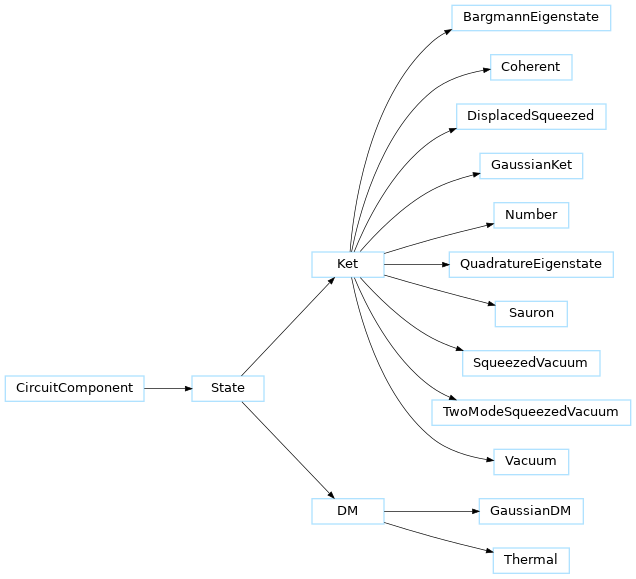
BargmannEigenstate
- class mrmustard.lab.states.BargmannEigenstate(mode, alpha=0j, name=None)[source]
Bases:
KetThe Bargmann eigenstate.
>>> from mrmustard.lab import BargmannEigenstate
>>> state = BargmannEigenstate(mode=1, alpha=0.1 + 0.5j)
>>> assert state.modes == (1,)
- Parameters:
mode (int | tuple[int]) – The mode of the Bargmann eigenstate.
alpha (complex | Sequence[complex] | Parameter) – The displacement of the state (i.e., the eigen-value).
name (str | None) – A name for the state. If not provided, the class name will be used.
Note
The only difference with
Coherent(mode, alpha)is in its c parameter (and hence, does not have unit norm).Details and Conventions
Its
(A,b,c)triple is given by\[A = 0 , b = \alpha, c = 1.\]
Coherent
- class mrmustard.lab.states.Coherent(mode, alpha=0j, name=None)[source]
Bases:
KetThe coherent state in Bargmann representation.
>>> from mrmustard.lab import Coherent, Vacuum, Dgate
>>> state = Coherent(mode=0, alpha=0.3 + 0.2j)
>>> assert state == Vacuum(0) >> Dgate(0, alpha=0.3 + 0.2j)
- Parameters:
mode (int | tuple[int]) – The mode of the coherent state.
alpha (complex | Sequence[complex] | Parameter) – The alpha displacement of the coherent state.
name (str | None) – A name for the state. If not provided, the class name will be used.
- Returns:
A
Ketobject representing a coherent state.
Details and Conventions
For any \(\bar{\alpha} = \bar{x} + i\bar{y}\) of length \(N\), the \(N\)-mode coherent state displaced \(N\)-mode vacuum state is defined by
\[V = \frac{\hbar}{2}I_N \text{and } r = \sqrt{2\hbar}[\text{Re}(\bar{\alpha}), \text{Im}(\bar{\alpha})].\]Its
(A,b,c)triple is given by\[A = O_{N\text{x}N}\text{, }b=\bar{\alpha}\text{, and }c=\text{exp}\big(-|\bar{\alpha}^2|/2\big).\]Note that vector of means in phase space for a coherent state with parameters
x,yisnp.sqrt(2)*x, np.sqrt(2)*y(with unitssettings.HBAR=1).
DM
- class mrmustard.lab.states.DM(ansatz_factory=None, wires=None, name=None)[source]
Bases:
StateBase class for density matrices.
- Parameters:
ansatz_factory (AnsatzFactory | None)
wires (Wires | None)
name (str | None)
- property is_positive: bool
Whether this DM corresponds to a positive operator.
>>> from mrmustard.lab import GaussianDM
>>> assert GaussianDM.random([0]).is_positive
- Raises:
NotImplementedError – If the state is mixed.
NotImplementedError – If the state has derived variables.
NotImplementedError – If the state has an
ArrayAnsatz.
- property is_physical: bool
Whether this DM is a physical density operator.
>>> from mrmustard.lab import GaussianDM
>>> assert GaussianDM.random([0]).is_physical
- property probability: float
Probability (trace) of this DM, using the batch dimension of the Ansatz as a convex combination of states.
- property purity: float
Computes the purity (\(tr(rho^2)\)) of this DM.
>>> from mrmustard import math
>>> from mrmustard.lab import DM, Vacuum
>>> assert math.allclose(Vacuum([0]).dm().purity, 1.0)
- classmethod from_bargmann(modes, triple, name=None, lin_sup=False)[source]
Initializes a state of type
clsfrom an(A, b, c)triple parametrizing the Ansatz in Bargmann representation.>>> from mrmustard.physics.ansatz import PolyExpAnsatz >>> from mrmustard.physics.triples import coherent_state_Abc >>> from mrmustard.lab.states.ket import Ket >>> modes = (0,) >>> triple = coherent_state_Abc(alpha=0.1) >>> coh = Ket.from_bargmann(modes, triple) >>> assert coh.modes == modes >>> assert coh.ansatz == PolyExpAnsatz(*triple) >>> assert isinstance(coh, Ket)
- Parameters:
modes (Sequence[int]) – The modes of this state.
triple (tuple[mrmustard.utils.typing.Matrix, mrmustard.utils.typing.Vector, mrmustard.utils.typing.Scalar]) – The
(A, b, c)triple.name (str | None) – The name of this state.
lin_sup (bool) – Whether to include linear superposition axes in the batch dimensions.
- Returns:
A
State.- Raises:
ValueError – If the
Aorbhave a shape that is inconsistent with the number of modes.- Return type:
- classmethod from_fock(modes, array, name=None, batch_dims=0)[source]
Initializes a state of type
clsfrom an array parametrizing the state in Fock representation.>>> from mrmustard.physics.ansatz import ArrayAnsatz >>> from mrmustard.lab import Coherent, Ket >>> array = Coherent(mode=0, alpha=0.1).to_fock().ansatz.array >>> coh = Ket.from_fock((0,), array, batch_dims=0) >>> assert coh.modes == (0,) >>> assert coh.ansatz == ArrayAnsatz(array, batch_dims=0) >>> assert isinstance(coh, Ket)
- Parameters:
modes (Sequence[int]) – The modes of this state.
array (ComplexTensor) – The Fock array.
name (str | None) – The name of this state.
batch_dims (int) – The number of batch dimensions in the given array.
- Returns:
A
State.- Raises:
ValueError – If the given array has a shape that is inconsistent with the number of modes.
- Return type:
- classmethod from_ansatz(modes, ansatz=None, name=None)[source]
Initializes a state of type
clsgiven modes and an ansatz.>>> from mrmustard import math >>> from mrmustard.lab import Ket >>> from mrmustard.physics.ansatz import PolyExpAnsatz >>> A = math.astensor([[0,.5], [.5,0]]) >>> b = math.astensor([2-1j,2+1j]) >>> c = 1 >>> psi = Ket.from_ansatz([0,1], PolyExpAnsatz(A,b,c)) >>> assert isinstance(psi, Ket)
- Parameters:
modes (Collection[int]) – The modes of this state.
ansatz (PolyExpAnsatz | ArrayAnsatz | None) – The ansatz of this state.
name (str | None) – The name of this state.
- Returns:
A state.
- Return type:
- classmethod from_phase_space(modes, triple, name=None, atol_purity=None)[source]
Initializes a density matrix from the covariance matrix, vector of means and a coefficient, which parametrize the s-parametrized phase space function \(coeff * exp(-1/2(x-means)^T cov^{-1} (x-means))\).h:coeff * exp((x-means)^T cov^{-1} (x-means)).
>>> from mrmustard import math
>>> from mrmustard.lab import DM, Vacuum
>>> rho = DM.from_phase_space([0], (math.eye(2)/2, [0,0], 1))
>>> assert rho == Vacuum([0]).dm()
- Parameters:
modes (Collection[int]) – The modes of this states.
triple (tuple[mrmustard.utils.typing.Matrix, mrmustard.utils.typing.Vector, mrmustard.utils.typing.Scalar]) – The
(cov, means, coeff)triple.name (str | None) – The name of this state.
atol_purity (float | None) – Unused argument.
- Returns:
A
DMobject from its phase space representation.- Return type:
Details and Conventions
The Wigner function is considered as \(coeff * exp(-1/2(x-means)^T cov^{-1} (x-means))\).h:coeff * exp((x-means)^T cov^{-1} (x-means)).
- classmethod from_quadrature(modes, triple, phi=0.0, name=None)[source]
Initializes a state from a triple (A,b,c) that parametrizes the wavefunction as c * exp(0.5 z^T A z + b^T z) in the quadrature representation.
- Parameters:
modes (Sequence[int]) – The modes of this state.
triple (tuple[mrmustard.utils.typing.Matrix, mrmustard.utils.typing.Vector, mrmustard.utils.typing.Scalar]) – The
(A, b, c)triple.phi (float) – The angle of the quadrature. 0 corresponds to the x quadrature (default).
name (str | None) – The name of this state.
- Returns:
A state of type
cls.- Raises:
ValueError – If the given triple has shapes that are inconsistent with the number of modes.
- Return type:
- dm()[source]
The
DMobject obtained from thisDM.>>> from mrmustard.lab import Vacuum, DM >>> assert isinstance(Vacuum([0]).dm(), DM)
- Returns:
A
DM.- Return type:
- expectation(operator)[source]
The expectation value of an operator with respect to this DM.
Given the operator O, this function returns \(Tr\big(\rho O)\), where \(\rho\) is the density matrix of this state.
The
operatoris expected to be a component with ket-like wires (i.e., output wires on the ket side), density matrix-like wires (output wires on both ket and bra sides), or unitary-like wires (input and output wires on the ket side).>>> from mrmustard import math >>> from mrmustard.lab import Rgate, GaussianDM >>> beta = 1 >>> symplectic = math.eye(2) >>> rho = GaussianDM([0], beta, symplectic) >>> answer = (1-math.exp(-beta))/(1+math.exp(-beta)) >>> assert math.allclose(rho.expectation(Rgate(0, np.pi)), answer)
- Parameters:
operator (CircuitComponent) – A ket-like, density-matrix like, or unitary-like circuit component.
- Returns:
Expectation value either as a complex number or a batch of complex numbers.
- Raises:
ValueError – If the operator is not a ket-like, density-matrix like, or unitary-like component.
ValueError – If the operator is defined over a set of modes that is not a subset of the modes of this state.
ValueError – If the modes in common between the operator and the state are not a subset of the modes of the operator.
- Return type:
- fidelity(other)[source]
The fidelity between this DM and another ket or DM. If the other state is a Ket, fidelity is computed as the squared overlap, consistent with the pure state’s fidelity. If the other state is a DM and the representation is Fock, the fidelity is computed as in Richard Jozsa (1994) Fidelity for Mixed Quantum States, Journal of Modern Optics, 41:12, 2315-2323, DOI: 10.1080/09500349414552171 Otherwise, the fidelity is computed as the Gaussian fidelity as in arXiv:2102.05748 <https://arxiv.org/pdf/2102.05748.pdf> (square definition).
- fock_array(shape=None, standard_order=False)[source]
Returns an array representation of this component in the Fock basis with the given shape.
The
standard_orderboolean argument lets one choose the standard convention for the index ordering of the density matrix. For a single mode, ifstandard_order=Truethe returned 2D array \(rho_{ij}\) has a first index corresponding to the “left” (ket) side of the matrix and the second index to the “right” (bra) side. Otherwise, MrMustard’s convention is that the bra index comes before the ket index. In other words, for a single mode, the array returned byfock_arraywithstandard_order=False(false by default) is the transpose of the standard density matrix. For multiple modes, the same applies to each pair of indices of each mode.>>> from mrmustard import math >>> from mrmustard.lab import Vacuum, DM >>> assert math.allclose(Vacuum([0]).dm().fock_array(), math.astensor([[1]]))
- Parameters:
shape (int | Sequence[int] | None) – The shape of the returned representation. If
shapeis given as anint, it is broadcasted to all the dimensions. If not given, it is generated viaauto_shape.standard_order (bool) – The ordering of the wires. If
standard_order = False, then the conventional ordering of bra-ket is chosen. However, if one wants to get the actual matrix representation in the standard conventions of linear algebra, thenstandard_order=Truemust be chosen.
- Returns:
The Fock representation of this component.
- Return type:
array
- Raises:
ValueError – If the shape is not valid for the component.
Note
The
standard_orderboolean argument lets one choose the standard convention for the index ordering of the density matrix. For a single mode, ifstandard_order=Truethe returned 2D array \(rho_{ij}\) has a first index corresponding to the “left” (ket) side of the matrix and the second index to the “right” (bra) side. Otherwise, MrMustard’s convention is that the bra index comes before the ket index. In other words, for a single mode, the array returned byfock_arraywithstandard_order=False(false by default) is the transpose of the standard density matrix. For multiple modes, the same applies to each pair of indices of each mode.
- formal_stellar_decomposition(core_modes)[source]
Computes the formal stellar decomposition for the DM.
>>> from mrmustard.lab import GaussianDM, Vacuum
>>> rho = GaussianDM.random([0,1])
>>> core, phi = rho.formal_stellar_decomposition([0])
>>> assert (core >> Vacuum(1).dual).normalize() == Vacuum(0).dm()
>>> assert rho == core >> phi
>>> assert (core >> Vacuum(1).dual).normalize() == Vacuum(0).dm()
- Parameters:
core_modes (Collection[int]) – The set of modes defining core variables.
- Returns:
The core state (DM) and the Gaussian Map performing the stellar decomposition (not necessarily CPTP).
- Return type:
Note
This method pulls out the map
phifrom the given state on the given modes, so that the remaining state is a core state. Formally, we have .. math:\rho = (\phi\otimes\mathcal I) \rho_{\mathrm{core}}
where the map \(phi\) acts on the given core_modes only. Core states have favorable properties in the Fock representation e.g., being sparse.
- physical_stellar_decomposition(core_modes)[source]
Applies the physical stellar decomposition.
When the number of core modes equals exactly half of the total modes (and n_modes is even), returns a
Ketcore andChannel. Otherwise, returns aDMcore andChannel.>>> from mrmustard.lab import GaussianDM, Vacuum >>> rho = GaussianDM.random([0, 1]) >>> core, phi = rho.physical_stellar_decomposition([0]) >>> assert rho == core >> phi >>> assert (core >> Vacuum(1).dual).normalize() == Vacuum(0)
- Parameters:
core_modes (Collection[int]) – The core modes defining the core variables.
- Returns:
The core state (DM or Ket depending on the number of core modes) and the channel acting on the core modes.
- Raises:
ValueError – If the rank condition is not satisfied (when core modes < half).
- Return type:
DisplacedSqueezed
- class mrmustard.lab.states.DisplacedSqueezed(mode, alpha=0j, r=0.0, phi=0.0, name=None)[source]
Bases:
KetThe displaced squeezed state in Bargmann representation.
>>> from mrmustard.lab import DisplacedSqueezed, Vacuum, Sgate, Dgate
>>> state = DisplacedSqueezed(mode=0, alpha=1, r=0.2, phi=0.3)
>>> assert state == Vacuum(0) >> Sgate(0, r=0.2, phi=0.3) >> Dgate(0, alpha=1)
- Parameters:
mode (int | tuple[int]) – The mode of the displaced squeezed state.
alpha (complex | Sequence[complex] | Parameter) – The complex displacement.
r (float | Sequence[float] | Parameter) – The squeezing magnitude.
phi (float | Sequence[float] | Parameter) – The squeezing angle.
name (str | None) – A name for the state. If not provided, the class name will be used.
- Returns:
A
Ket.
GaussianDM
- class mrmustard.lab.states.GaussianDM(modes, beta, symplectic, name=None)[source]
Bases:
DMThe N-mode mixed state described by a Gaussian gate that acts on a given thermal state. This corresponds to the Williamson form. It is equivalent to the construction
Thermal(beta) >> Ggate(symplectic).>>> from mrmustard.lab import GaussianDM, DM >>> rho = GaussianDM.random(modes=0) >>> assert isinstance(rho, DM)
- Parameters:
modes (int | tuple[int, ...]) – The modes over which the state is defined.
beta (float | Sequence[float] | Parameter) – the set of temperatures determining the thermal states. If only a float is provided for a multi-mode state, the same temperature is considered across all modes.
symplectic (RealMatrix | Parameter) – The symplectic representation of the unitary that acts on a vacuum to produce the desired state.
name (str | None) – A name for the state. If not provided, the class name will be used.
- Returns:
A
GaussianDM.
Details and Conventions
For a given Gaussian unitary U (that is determined by its symplectic representation), and a set of temperatures, produces the state
\[\rho = U (\bigotimes_i \rho_t(\beta_i))\]where rho_t are thermal states with temperatures determined by beta.
- classmethod random(modes, max_r=1.0, min_beta=0.2, max_beta=1.0, max_disp=None, seed=None, name=None)[source]
Returns a random
GaussianDM, optionally displaced.Constructed as
Thermal(beta) >> Ggate(symplectic), for a randombetaand a randomsymplectic. If a specificbetais required, use the constructionThermal(beta) >> Ggate.random()where beta is the desired inverse temperature. To obtain random Gaussian density matrices from the induced trace measure, use the constructionGaussianKet.random().get_modes()with appropriate modes.When
max_dispis given, each mode is displaced by a random complex amplitude sampled uniformly from the disk of radiusmax_disp.- Parameters:
modes (int | tuple[int, ...]) – The modes of the GaussianDM.
max_r (float) – Maximum squeezing parameter for the Gaussian unitary. Default is 1.0.
min_beta (float) – Minimum inverse temperature that will be sampled. Default is 0.5.
max_beta (float) – Maximum inverse temperature that will be sampled. Default is 1.0.
max_disp (float | None) – Maximum displacement amplitude. Each mode gets an independent displacement sampled uniformly from the disk
|alpha| <= max_disp. IfNone, no displacement is applied.seed (int | None) – The random seed. If
None, the global seed is used.name (str | None) – A name for the state. If not provided, the class name will be used.
- Returns:
The random state (
GaussianDMif no displacement,DMotherwise).- Raises:
ValueError – if
modesis an empty tuple.- Return type:
GaussianKet
- class mrmustard.lab.states.GaussianKet(modes, symplectic, name=None)[source]
Bases:
KetThe N-mode pure state described by a Gaussian gate that acts on Vacuum.
>>> from mrmustard.lab import GaussianKet, Ket
>>> psi = GaussianKet.random(modes=0)
>>> assert isinstance(psi, Ket)
- Parameters:
modes (int | tuple[int, ...]) – The modes over which the state is defined.
symplectic (RealMatrix | Parameter) – The symplectic representation of the unitary that acts on
state. (vacuum to produce the desired)
name (str | None) – A name for the state. If not provided, the class name will be used.
- Returns:
A
GaussianKet.
Details and Conventions
For a given Gaussian unitary U (that is determined by its symplectic representation), produces the state
\[|\psi\rangle = U |0\rangle\]- classmethod random(modes, max_r=1.0, max_disp=None, seed=None, name=None)[source]
Returns a random GaussianKet, optionally displaced.
When
max_dispis given, each mode is displaced by a random complex amplitude sampled uniformly from the disk of radiusmax_disp.- Parameters:
modes (int | tuple[int, ...]) – The modes of the GaussianKet.
max_r (float) – Maximum squeezing parameter over which we make random choices.
max_disp (float | None) – Maximum displacement amplitude. Each mode gets an independent displacement sampled uniformly from the disk
|alpha| <= max_disp. IfNone, no displacement is applied.seed (int | None) – The random seed. If
None, the global seed is used.name (str | None) – A name for the state. If not provided, the class name will be used.
- Returns:
The random state (
GaussianKetif no displacement,Ketotherwise).- Raises:
ValueError – if
modesis an empty tuple.- Return type:
Ket
- class mrmustard.lab.states.Ket(ansatz_factory=None, wires=None, name=None)[source]
Bases:
StateBase class for all Hilbert space vectors.
- Parameters:
ansatz_factory (AnsatzFactory | None)
wires (Wires | None)
name (str | None)
- property is_physical: bool
Whether the ket object is a physical one.
>>> from mrmustard.lab import GaussianKet
>>> psi = GaussianKet.random([0])
>>> assert psi.is_physical
- Returns:
A boolean variable.
- Raises:
NotImplementedError – If the state is in a linear superposition.
NotImplementedError – If the state has derived variables.
NotImplementedError – If the state has an
ArrayAnsatz.
- property probability: float
Probability of this Ket (L2 norm squared).
>>> from mrmustard import math
>>> from mrmustard.lab import GaussianKet
>>> psi = GaussianKet.random([0])
>>> assert math.allclose(psi.probability, 1.0)
- Returns:
The probability of this
Ket.
- property purity: float
The purity of the state.
>>> from mrmustard.lab import GaussianKet
>>> assert GaussianKet.random([0]).purity == 1.0
- Returns:
The purity of this
Ket(always 1.0).
- classmethod from_bargmann(modes, triple, name=None, lin_sup=False)[source]
Initializes a state of type
clsfrom an(A, b, c)triple parametrizing the Ansatz in Bargmann representation.>>> from mrmustard.physics.ansatz import PolyExpAnsatz >>> from mrmustard.physics.triples import coherent_state_Abc >>> from mrmustard.lab.states.ket import Ket >>> modes = (0,) >>> triple = coherent_state_Abc(alpha=0.1) >>> coh = Ket.from_bargmann(modes, triple) >>> assert coh.modes == modes >>> assert coh.ansatz == PolyExpAnsatz(*triple) >>> assert isinstance(coh, Ket)
- Parameters:
modes (Sequence[int]) – The modes of this state.
triple (tuple[mrmustard.utils.typing.Matrix, mrmustard.utils.typing.Vector, mrmustard.utils.typing.Scalar]) – The
(A, b, c)triple.name (str | None) – The name of this state.
lin_sup (bool) – Whether to include linear superposition axes in the batch dimensions.
- Returns:
A
State.- Raises:
ValueError – If the
Aorbhave a shape that is inconsistent with the number of modes.- Return type:
- classmethod from_fock(modes, array, name=None, batch_dims=0)[source]
Initializes a state of type
clsfrom an array parametrizing the state in Fock representation.>>> from mrmustard.physics.ansatz import ArrayAnsatz >>> from mrmustard.lab import Coherent, Ket >>> array = Coherent(mode=0, alpha=0.1).to_fock().ansatz.array >>> coh = Ket.from_fock((0,), array, batch_dims=0) >>> assert coh.modes == (0,) >>> assert coh.ansatz == ArrayAnsatz(array, batch_dims=0) >>> assert isinstance(coh, Ket)
- Parameters:
modes (Sequence[int]) – The modes of this state.
array (ComplexTensor) – The Fock array.
name (str | None) – The name of this state.
batch_dims (int) – The number of batch dimensions in the given array.
- Returns:
A
State.- Raises:
ValueError – If the given array has a shape that is inconsistent with the number of modes.
- Return type:
- classmethod from_ansatz(modes, ansatz=None, name=None)[source]
Initializes a state of type
clsgiven modes and an ansatz.>>> from mrmustard import math >>> from mrmustard.lab import Ket >>> from mrmustard.physics.ansatz import PolyExpAnsatz >>> A = math.astensor([[0,.5], [.5,0]]) >>> b = math.astensor([2-1j,2+1j]) >>> c = 1 >>> psi = Ket.from_ansatz([0,1], PolyExpAnsatz(A,b,c)) >>> assert isinstance(psi, Ket)
- Parameters:
modes (Collection[int]) – The modes of this state.
ansatz (PolyExpAnsatz | ArrayAnsatz | None) – The ansatz of this state.
name (str | None) – The name of this state.
- Returns:
A state.
- Return type:
- classmethod from_phase_space(modes, triple, name=None, atol_purity=None)[source]
Initializes a state from the covariance matrix and the vector of means of a state in phase space.
>>> from mrmustard import math
>>> from mrmustard.lab import Ket, Vacuum
>>> assert Ket.from_phase_space([0], (math.eye(2)/2, [0,0], 1)) == Vacuum([0])
Note
If the given covariance matrix and vector of means are consistent with a pure state, a
Ketis returned. Otherwise, aDMis returned. One can skip this check by settingatol_puritytoNone(atol_puritydefaults toNone).- Parameters:
modes (Collection[int]) – The modes of this states.
triple (tuple[mrmustard.utils.typing.Matrix, mrmustard.utils.typing.Vector, mrmustard.utils.typing.Scalar]) – A covariance matrix, vector of means, and constant multiple triple.
name (str | None) – The name of this state.
atol_purity (float | None) – If
atol_purityis given, the purity of the state is computed, and an error is raised if its value is smaller than1-atol_purityor larger than1+atol_purity. IfNone, this check is skipped.
- Returns:
A
State.- Raises:
ValueError – If the given
covandmeanshave shapes that are inconsistent with the number of modes.ValueError – If
atol_purityis notNoneand the purity of the returned state is smaller than1-atol_purityor larger than1+atol_purity.
- Return type:
- classmethod from_quadrature(modes, triple, phi=0.0, name=None)[source]
Initializes a state from a triple (A,b,c) that parametrizes the wavefunction as c * exp(0.5 z^T A z + b^T z) in the quadrature representation.
- Parameters:
modes (Sequence[int]) – The modes of this state.
triple (tuple[mrmustard.utils.typing.Matrix, mrmustard.utils.typing.Vector, mrmustard.utils.typing.Scalar]) – The
(A, b, c)triple.phi (float) – The angle of the quadrature. 0 corresponds to the x quadrature (default).
name (str | None) – The name of this state.
- Returns:
A state of type
cls.- Raises:
ValueError – If the given triple has shapes that are inconsistent with the number of modes.
- Return type:
- dm()[source]
The
DMobject obtained from thisKet.>>> from mrmustard.lab import Vacuum, DM >>> assert isinstance(Vacuum([0]).dm(), DM)
- Returns:
A
DM.- Return type:
- expectation(operator)[source]
The expectation value of an operator calculated with respect to this Ket.
>>> from mrmustard import math
>>> from mrmustard.lab import Number, Rgate
>>> psi = Number(0, 1)
>>> theta = 0.123
>>> answer = math.exp(1j*theta)
>>> assert math.allclose(psi.expectation(Rgate(0, theta)), answer)
- Parameters:
operator (CircuitComponent) – A ket-like, density-matrix like, or unitary-like circuit component.
- Returns:
Expectation value as a complex number.
- Raises:
ValueError – If the operator is not a ket-like, density-matrix like, or unitary-like component.
ValueError – If the operator is defined over a set of modes that is not a subset of the modes of this state.
ValueError – If the modes in common between the operator and the state are not a subset of the modes of the operator.
- Return type:
Note
Given the operator O, this function returns \(Tr\big(|\psi\rangle\langle\psi| O)\), where \(|\psi\rangle\) is the vector representing this state.
The
operatoris expected to be a component with ket-like wires (i.e., output wires on the ket side), density matrix-like wires (output wires on both ket and bra sides), or unitary-like wires (input and output wires on the ket side).
- fidelity(other)[source]
The fidelity between this ket and another state.
Details and Conventions
\[F(|\psi\rangle, \phi\rangle) = |\langle \psi, \phi \rangle|^2\]
- formal_stellar_decomposition(core_modes)[source]
Applies the formal stellar decomposition.
>>> from mrmustard.lab import GaussianKet
>>> psi = GaussianKet.random([0,1])
>>> core, t = psi.formal_stellar_decomposition([0])
>>> A_core = core.ansatz.A
>>> assert A_core[0,0] == 0
- Parameters:
core_modes (Collection[int]) – The set of modes defining core variables.
- Returns:
The core state (Ket) and the Gaussian Operation performing the stellar decomposition.
- Return type:
Note
This method pulls out the unitary
Ufrom the given state on the given modes, so that the remaining state is a core state. Formally, we have .. math:\psi = (T\otimes\mathbb I) S_{\mathrm{core}}
where the operator \(T\) acts on the given core_modes only. Core states have favorable properties in the Fock representation e.g., being sparse.
- physical_stellar_decomposition(core_modes)[source]
Applies the physical stellar decomposition.
>>> from mrmustard import math
>>> from mrmustard.lab import GaussianKet
>>> psi = GaussianKet.random([0,1])
>>> core, U = psi.physical_stellar_decomposition([0])
>>> assert psi == core >> U
>>> A_c = core.ansatz.A
>>> assert math.allclose(A_c[0,0], 0)
- Parameters:
core_modes (Collection[int]) – The set of modes defining core variables.
- Returns:
The core state (Ket) and the Gaussian unitary performing the stellar decomposition.
- Return type:
Note
This method pulls out the unitary U from the given state on the given modes, so that the remaining state is a core state. Formally, we have
\[\psi = (U\otimes\mathbb I) \psi_{\mathrm{core}}\]where the unitary U acts on the given core_modes only. Core states have favorable properties in the Fock representation e.g., being sparse.
- stellar_roots(max_degree=None)[source]
Compute the stellar roots of this single-mode ket.
The stellar roots are the zeros of the Bargmann polynomial
\[F(z) = \sum_n c_n z^n / \sqrt{n!}\]built from the Fock amplitudes \(c_{n}\) of this state.
For states already in Fock representation the amplitudes are used directly. For Bargmann states whose
ctensor is scalar (i.e. pure Gaussian states with no polynomial part) there are no finite roots and an empty array is returned. For Bargmann states with a non-scalarcthe state is converted to Fock using the polynomial degree (or the explicitmax_degreeif provided, clamped to the true polynomial degree to avoid spurious roots from the Gaussian envelope). The polynomial degree issum(n_i - 1)wheren_iare the dimensions of the derived-variable part ofc.- Parameters:
max_degree (int | None) – Maximum polynomial degree for computing the roots. For
PolyExpAnsatzstates this is clamped to the true polynomial degree. IfNone, the degree is inferred from the ansatz.- Returns:
Complex 1D array of stellar roots (empty for Gaussian states).
- Raises:
ValueError – If the state has more than one mode or is batched.
- Return type:
ndarray
- plot_stellar_roots(max_degree=None, *, ax=None, max_limit=10.0)[source]
Plot the stellar roots of this single-mode ket.
Each root is plotted in the complex plane and colored by its phase angle via the HSV colormap.
- Parameters:
max_degree (int | None) – Maximum polynomial degree for computing the roots. If
None, the degree is inferred from the ansatz.ax (Axes | None) – Optional matplotlib
Axesto draw on. When provided the roots are drawn on the existing axes (no new figure is created andplt.show()is not called). Useful with the ipympl backend for flicker-free interactive updates.max_limit (float) – Maximum absolute value for each axis.
- Returns:
The matplotlib
Axesinstance used for the plot.- Raises:
ValueError – If the state has more than one mode or is batched.
- Return type:
Axes
Number
- class mrmustard.lab.states.Number(mode, n, cutoff=None, name=None)[source]
Bases:
KetThe number state in Fock representation.
>>> from mrmustard.lab import Number
>>> from mrmustard.physics.ansatz import ArrayAnsatz
>>> state = Number(mode=0, n=10)
>>> assert isinstance(state.ansatz, ArrayAnsatz)
- Parameters:
mode (int | tuple[int]) – The mode of the number state.
n (int | Sequence[int]) – The (batchable) number of photons.
cutoff (int | None) – The photon cutoff. If
cutoffisNone, it defaults tomath.max(n).name (str | None) – A name for the state. If not provided, the class name will be used.
Details and Conventions
For any \(\bar{n} = (n_1,\:\ldots,\:n_N)\), the \(N\)-mode number state is defined by
\[\ket{\bar{n}} = \ket{n_1}\otimes\ldots\otimes\ket{n_N}\:,\]where \(\ket{n_j}\) is the eigenstate of the number operator on mode j with eigenvalue \(n_j\).
QuadratureEigenstate
- class mrmustard.lab.states.QuadratureEigenstate(mode, x=0.0, phi=0.0, name=None)[source]
Bases:
KetThe Quadrature eigenstate in Bargmann representation.
>>> from mrmustard.lab import QuadratureEigenstate
>>> state = QuadratureEigenstate(1, x = 1, phi = 0)
>>> assert state.modes == (1,)
- Parameters:
mode (int | tuple[int]) – The mode of the quadrature eigenstate.
x (float | Sequence[float] | Parameter) – The displacement of the state.
phi (float | Sequence[float] | Parameter) – The angle of the state with 0 being a position eigenstate and pi/2 being the momentum eigenstate.
name (str | None) – A name for the state. If not provided, the class name will be used.
Details and Conventions
Its
(A,b,c)triple is given by\[A = -I_{N}\exp(i2\phi)\text{, }b = I_Nx\exp(i\phi)\sqrt{2/\hbar}\text{, and }c = 1/(\pi\hbar)^{-1/4}\exp(-\abs{x}^2/(2\hbar)).\]- property L2_norm
The L2 norm of this quadrature eigenstate.
Sauron
- class mrmustard.lab.states.Sauron(mode, n, epsilon=0.1, name=None)[source]
Bases:
KetThe n-th Sauron state is an approximation of the n-th Fock states using a ring of n+1 coherent states.
>>> from mrmustard.lab import Sauron
>>> psi = Sauron(0, 1)
>>> assert psi.modes == (0,)
- Parameters:
mode (int | tuple[int]) – The mode of the Sauron state.
n (int) – The Fock state that is approximated.
epsilon (float) – The radius of the ring of coherent states, default is 0.1.
name (str | None) – A name for the state. If not provided, the class name will be used.
Note
The reference to the Lord of the Rings comes from the approximation becoming perfect in the limit for the radius of the ring going to zero where vacuum (= darkness) is. The formula for the Sauron state as a superposition of coherent states on a ring is given in https://arxiv.org/abs/2305.17099:
\[|\text{Sauron}(n)\rangle = \frac{1}{\mathcal{N}}\sum_{k=0}^{n} e^{i 2\pi k/(n+1)} |\epsilon e^{2\pi k/(n+1)}\rangle_c,\]
SqueezedVacuum
- class mrmustard.lab.states.SqueezedVacuum(mode, r=0.0, phi=0.0, name=None)[source]
Bases:
KetThe squeezed vacuum state in Bargmann representation.
>>> from mrmustard.lab import SqueezedVacuum, Vacuum, Sgate
>>> state = SqueezedVacuum(mode=0, r=0.3, phi=0.2)
>>> assert state == Vacuum(0) >> Sgate(0, r=0.3, phi=0.2)
State
- class mrmustard.lab.states.State(ansatz_factory=None, wires=None, name=None)[source]
Bases:
CircuitComponentBase class for all states.
- Parameters:
ansatz_factory (AnsatzFactory | None)
wires (Wires | None)
name (str | None)
- property is_pure
Whether this state is pure.
- property is_separable
Check if a multi-mode quantum state is separable based on the von Neumann entropy.
- Returns:
Whether the state is separable.
- Raises:
NotImplementedError – If the state is a linear superposition.
- property L2_norm: float
The L2 norm squared of a
Ket, or the Hilbert-Schmidt norm of aDM.>>> from mrmustard import math >>> from mrmustard.lab import GaussianKet >>> state = GaussianKet.random([0]) >>> assert math.allclose(state.L2_norm, 1.0)
- abstract property probability: float
Returns \(\langle\psi|\psi\rangle\) for
Ketstates \(|\psi\rangle\) and \(\text{Tr}(\rho)\) forDMstates \(\rho\).
- abstract property purity: float
The purity of this state.
- property wigner
Returns the Wigner function of this state in phase space as an
Ansatz.>>> import numpy as np >>> from mrmustard.lab import GaussianKet >>> state = GaussianKet.random([0]) >>> x = np.linspace(-5, 5, 100) >>> assert np.all(state.wigner(x,0).real >= 0)
- classmethod from_bargmann(modes, triple, name=None, lin_sup=False)[source]
Initializes a state of type
clsfrom an(A, b, c)triple parametrizing the Ansatz in Bargmann representation.>>> from mrmustard.physics.ansatz import PolyExpAnsatz >>> from mrmustard.physics.triples import coherent_state_Abc >>> from mrmustard.lab.states.ket import Ket >>> modes = (0,) >>> triple = coherent_state_Abc(alpha=0.1) >>> coh = Ket.from_bargmann(modes, triple) >>> assert coh.modes == modes >>> assert coh.ansatz == PolyExpAnsatz(*triple) >>> assert isinstance(coh, Ket)
- Parameters:
modes (Sequence[int]) – The modes of this state.
triple (tuple[mrmustard.utils.typing.Matrix, mrmustard.utils.typing.Vector, mrmustard.utils.typing.Scalar]) – The
(A, b, c)triple.name (str | None) – The name of this state.
lin_sup (bool) – Whether to include linear superposition axes in the batch dimensions.
- Returns:
A
State.- Raises:
ValueError – If the
Aorbhave a shape that is inconsistent with the number of modes.- Return type:
Self
- classmethod from_fock(modes, array, name=None, batch_dims=0)[source]
Initializes a state of type
clsfrom an array parametrizing the state in Fock representation.>>> from mrmustard.physics.ansatz import ArrayAnsatz >>> from mrmustard.lab import Coherent, Ket >>> array = Coherent(mode=0, alpha=0.1).to_fock().ansatz.array >>> coh = Ket.from_fock((0,), array, batch_dims=0) >>> assert coh.modes == (0,) >>> assert coh.ansatz == ArrayAnsatz(array, batch_dims=0) >>> assert isinstance(coh, Ket)
- Parameters:
modes (Sequence[int]) – The modes of this state.
array (ComplexTensor) – The Fock array.
name (str | None) – The name of this state.
batch_dims (int) – The number of batch dimensions in the given array.
- Returns:
A
State.- Raises:
ValueError – If the given array has a shape that is inconsistent with the number of modes.
- Return type:
Self
- abstract classmethod from_ansatz(modes, ansatz=None, name=None)[source]
Initializes a state of type
clsgiven modes and an ansatz.>>> from mrmustard import math >>> from mrmustard.lab import Ket >>> from mrmustard.physics.ansatz import PolyExpAnsatz >>> A = math.astensor([[0,.5], [.5,0]]) >>> b = math.astensor([2-1j,2+1j]) >>> c = 1 >>> psi = Ket.from_ansatz([0,1], PolyExpAnsatz(A,b,c)) >>> assert isinstance(psi, Ket)
- Parameters:
modes (Sequence[int]) – The modes of this state.
ansatz (PolyExpAnsatz | ArrayAnsatz | None) – The ansatz of this state.
name (str | None) – The name of this state.
- Returns:
A state.
- Return type:
Self
- abstract classmethod from_phase_space(modes, triple, name=None, atol_purity=None)[source]
Initializes a state from the covariance matrix and the vector of means of a state in phase space.
>>> from mrmustard import math
>>> from mrmustard.lab import Ket, Vacuum
>>> assert Ket.from_phase_space([0], (math.eye(2)/2, [0,0], 1)) == Vacuum([0])
Note
If the given covariance matrix and vector of means are consistent with a pure state, a
Ketis returned. Otherwise, aDMis returned. One can skip this check by settingatol_puritytoNone(atol_puritydefaults toNone).- Parameters:
modes (Sequence[int]) – The modes of this states.
triple (tuple[mrmustard.utils.typing.Matrix, mrmustard.utils.typing.Vector, mrmustard.utils.typing.Scalar]) – A covariance matrix, vector of means, and constant multiple triple.
name (str | None) – The name of this state.
atol_purity (float | None) – If
atol_purityis given, the purity of the state is computed, and an error is raised if its value is smaller than1-atol_purityor larger than1+atol_purity. IfNone, this check is skipped.
- Returns:
A
State.- Raises:
ValueError – If the given
covandmeanshave shapes that are inconsistent with the number of modes.ValueError – If
atol_purityis notNoneand the purity of the returned state is smaller than1-atol_purityor larger than1+atol_purity.
- Return type:
Self
- classmethod from_quadrature(modes, triple, phi=0.0, name=None)[source]
Initializes a state from a triple (A,b,c) that parametrizes the wavefunction as c * exp(0.5 z^T A z + b^T z) in the quadrature representation.
- Parameters:
modes (Sequence[int]) – The modes of this state.
triple (tuple[mrmustard.utils.typing.Matrix, mrmustard.utils.typing.Vector, mrmustard.utils.typing.Scalar]) – The
(A, b, c)triple.phi (float) – The angle of the quadrature. 0 corresponds to the x quadrature (default).
name (str | None) – The name of this state.
- Returns:
A state of type
cls.- Raises:
ValueError – If the given triple has shapes that are inconsistent with the number of modes.
- Return type:
Self
- auto_shape(max_prob=None, max_shape=None, min_shape=None, respect_manual_shape=True)[source]
Generates an estimate for the Fock shape. If the state is in Fock the core shape is used. If in Bargmann, the shape is computed as the shape that captures at least
settings.AUTOSHAPE_PROBABILITYof the probability mass of each single-mode marginal (default 99.9%) so long as the state has no derived variables and is unbatched. Otherwise, defaults tosettings.DEFAULT_FOCK_SIZE. Ifrespect_manual_shapeisTrue, the non-None values inself.manual_shapeare used to override the shape.>>> from mrmustard import math >>> from mrmustard.lab import Vacuum >>> assert math.allclose(Vacuum([0]).fock_array(), 1)
Note
If jitted, the shape will default to
settings.DEFAULT_FOCK_SIZE.- Parameters:
max_prob – The maximum probability mass to capture in the shape. Default is
settings.AUTOSHAPE_PROBABILITY.max_shape – The maximum shape cutoff. Default is
settings.AUTOSHAPE_MAX.min_shape – The minimum shape cutoff. Default is
settings.AUTOSHAPE_MIN.respect_manual_shape – Whether to respect the non-None values in
manual_shape. Default isTrue.
- Returns:
The Fock shape of this component.
- Return type:
tuple[int, …]
- fock_distribution(cutoff)[source]
Returns the Fock distribution of the state up to some cutoff.
- Parameters:
cutoff (int) – The photon cutoff (maximum photon number).
- Returns:
The Fock distribution including states from \(|0\rangle\) to \(|\text{cutoff}\rangle\).
- Return type:
- get_modes(modes)[source]
Reduced density matrix obtained by tracing out all the modes except those in
modes. Note that the result is returned with modes in increasing order.- Parameters:
modes (int | Sequence[int]) – The modes to keep.
- Returns:
A
Stateobject with the remaining modes.- Raises:
ValueError – If the modes to keep are not a subset of the modes of the state.
- Return type:
- wormhole_1mode(pnr_outcomes, output_cutoff, leftover_mode)[source]
Compute conditional single-mode states given PNR measurements.
Uses the wormhole algorithm to efficiently compute the conditional state of one “leftover” mode given photon number resolving (PNR) measurements on all other modes. This is much more efficient than computing the full Fock tensor and slicing for high photon counts.
Supports both single and batched states. For batched states, the computation is parallelized across batch elements for improved performance.
- Parameters:
pnr_outcomes (tuple[int, ...] | list[tuple[int, ...]]) – Either a single tuple or a list of tuples specifying photon counts for the measured modes. Each tuple has length n_modes - 1, with photon counts in mode order (excluding the leftover mode).
output_cutoff (int) – Maximum photon number for the output state.
leftover_mode (int) – The mode to keep unmeasured. Must be one of this state’s modes.
- Returns:
Dict mapping PNR tuples to State objects (same type as self). For batched input states, the returned states will also be batched.
- Raises:
ValueError – If this state has fewer than 2 modes.
ValueError – If leftover_mode is not one of this state’s modes.
ValueError – If pnr_outcomes tuples have wrong length.
- Return type:
dict[tuple[int, …], State]
Example
>>> import numpy as np
>>> from mrmustard.lab import GaussianKet
>>> ket = GaussianKet.random([0, 1], seed=42)
>>> pnr = (2,)
>>> cutoff = 5
>>> results = ket.wormhole_1mode(pnr, output_cutoff=cutoff, leftover_mode=0)
>>> cond_ket = results[pnr]
>>> cond_ket.fock_array().shape
(6,)
Note
The wormhole algorithm is particularly efficient for high photon counts where computing the full Fock tensor would be prohibitively expensive. Memory scaling depends on state type: O(2^M × cutoff) for Ket, O(4^M × cutoff²) for DM, where M is the number of measured modes.
- abstract formal_stellar_decomposition(core_modes)[source]
Applies the formal stellar decomposition.
- Parameters:
core_modes (Sequence[int]) – The set of modes defining core variables.
- Returns:
A tuple containing the core state and the Gaussian transformation performing the stellar decomposition.
- Return type:
tuple[State, Transformation]
- normalize()[source]
Returns a rescaled version of the state such that its probability is 1.
- Return type:
- phase_space(s)[source]
Returns the phase space parametrization of a state, consisting in a covariance matrix, a vector of means and a scaling coefficient. When a state is a linear superposition of Gaussians, each of cov, means, coeff are arranged in a batch.
Phase space representations are labelled by an
sparameter (float) which modifies the exponent of \(D_s(\gamma) = e^{\frac{s}{2}|\gamma|^2}D(\gamma)\), which is the operator basis used to expand phase space density matrices.The
sparameter typically takes the values of -1, 0, 1 to indicate Glauber/Wigner/Husimi functions.- Parameters:
s (float) – The phase space parameter
- Returns:
The covariance matrix, the mean vector and the coefficient of the state in s-parametrized phase space.
- Return type:
tuple
- abstract physical_stellar_decomposition(core_modes)[source]
Applies the physical stellar decomposition.
- Parameters:
core_modes (Sequence[int]) – The set of modes defining core variables.
- Returns:
A tuple containing the core state and the Gaussian transformation performing the stellar decomposition.
- Return type:
tuple[State, Transformation]
- quadrature_distribution(*quad, phi=0.0)[source]
The (discretized) quadrature distribution of the
State.- Parameters:
quad (RealVector) – the discretized quadrature axis over which the distribution is computed.
phi (float) – The quadrature angle.
0corresponds to the x quadrature,pi/2to the p quadrature.
- Returns:
The quadrature distribution.
- Return type:
- visualize_2d(xbounds=(-6, 6), pbounds=(-6, 6), resolution=200, colorscale='RdBu', return_fig=False, min_shape=50)[source]
2D visualization of the Wigner function of this state.
Plots the Wigner function on a heatmap, alongside the probability distributions on the two quadrature axis.
>>> from mrmustard.lab import Coherent
>>> state = Coherent(0, alpha=1) / 2**0.5 + Coherent(0, alpha=-1) / 2**0.5
>>> # state.visualize_2d()
- Parameters:
xbounds (tuple[int, int]) – The range of the x axis.
pbounds (tuple[int, int]) – The range of the p axis.
resolution (int) – The number of bins on each axes.
colorscale (str) – A colorscale. Must be one of
Plotly's built-in continuous color scales.return_fig (bool) – Whether to return the
Plotlyfigure.min_shape (int) – The minimum fock shape to use for the Wigner function plot.
- Returns:
A
Plotlyfigure representing the state in 2D.- Raises:
ValueError – If this state is a multi-mode state.
- Return type:
Figure | None
- visualize_2d_with_arrows(arrows, xbounds=(-6, 6), pbounds=(-6, 6), resolution=200, colorscale='RdBu', return_fig=False, min_shape=50)[source]
Plot the state Wigner function and q/p marginals along with arrows from the origin of the Wigner function.
Useful for, e.g., visualizing the stabilizer arguments of a GKP state.
- Parameters:
arrows (ndarray) – 1D numpy array of complex numbers representing arrow end-points.
xbounds (tuple[int, int]) – The range of the x axis.
pbounds (tuple[int, int]) – The range of the p axis.
resolution (int) – The number of bins on each axes.
colorscale (str) – A colorscale. Must be one of
Plotly’s built-in continuous color scales.return_fig (bool) – Whether to return the
Plotlyfigure.min_shape (int) – The minimum fock shape to use for the Wigner function plot.
- Returns:
A
Plotlyfigure.- Return type:
Figure | None
- visualize_3d(xbounds=(-6, 6), pbounds=(-6, 6), resolution=200, colorscale='RdBu', return_fig=False, min_shape=50)[source]
3D visualization of the Wigner function of this state on a surface plot.
- Parameters:
xbounds (tuple[int, int]) – The range of the x axis.
pbounds (tuple[int, int]) – The range of the p axis.
resolution (int) – The number of bins on each axes.
colorscale (str) – A colorscale. Must be one of
Plotly's built-in continuous color scales.return_fig (bool) – Whether to return the
Plotlyfigure.min_shape (int) – The minimum fock shape to use for the Wigner function plot.
- Returns:
A
Plotlyfigure representing the state in 3D.- Raises:
ValueError – If this state is a multi-mode state.
- Return type:
Figure | None
- visualize_dm(cutoff=None, return_fig=False)[source]
Plots the absolute value \(abs(\rho)\) of the density matrix \(\rho\) of this state on a heatmap.
- Parameters:
cutoff (int | None) – The desired cutoff. Defaults to the value of auto_shape.
return_fig (bool) – Whether to return the
Plotlyfigure.
- Returns:
A
Plotlyfigure representing absolute value of the density matrix of this state.- Raises:
ValueError – If this state is a multi-mode state.
- Return type:
Figure | None
Thermal
- class mrmustard.lab.states.Thermal(mode, nbar=0.0, name=None)[source]
Bases:
DMThe thermal state in Bargmann representation.
>>> from mrmustard.lab import Thermal
>>> state = Thermal(1, nbar=3)
>>> assert state.modes == (1,)
- Parameters:
mode (int | tuple[int]) – The mode of the thermal state.
nbar (float | Sequence[float] | Parameter) – The expected number of photons.
name (str | None) – A name for the state. If not provided, the class name will be used.
- Returns:
A
DMtype object that represents the thermal state.
TwoModeSqueezedVacuum
- class mrmustard.lab.states.TwoModeSqueezedVacuum(modes, r=0.0, phi=0.0, name=None)[source]
Bases:
KetThe two-mode squeezed vacuum state.
>>> from mrmustard.lab import TwoModeSqueezedVacuum, S2gate, Vacuum
>>> state = TwoModeSqueezedVacuum(modes=(0, 1), r=0.3, phi=0.2)
>>> assert state == Vacuum((0,1)) >> S2gate((0, 1), r=0.3, phi=0.2)
- Parameters:
- Returns:
A
Kettype object that represents the two-mode squeezed vacuum state.
Vacuum
- class mrmustard.lab.states.Vacuum(modes, name=None)[source]
Bases:
KetThe N-mode vacuum state in Bargmann representation.
>>> from mrmustard.lab import Vacuum
>>> state = Vacuum((1, 2))
>>> assert state.modes == (1, 2)
- Parameters:
modes (int | tuple[int, ...]) – A tuple of modes.
name (str | None) – A name for the state. If not provided, the class name will be used.
Details and Conventions
The \(N\)-mode vacuum state is defined by
\[V = \frac{\hbar}{2}I_N \text{and } r = \bar{0}_N.\]Its
(A,b,c)triple is given by\[A = O_{N\text{x}N}\text{, }b = O_N\text{, and }c = 1.\]- get_modes(modes)[source]
Reduced density matrix obtained by tracing out all the modes except those in
modes. Note that the result is returned with modes in increasing order.- Parameters:
modes (int | Collection[int]) – The modes to keep.
- Returns:
A
Stateobject with the remaining modes.- Raises:
ValueError – If the modes to keep are not a subset of the modes of the state.
- Return type: